Case Study
In-situ recovery amenability using WIREBmr™
13 Sept 2023
Site Profile
Uranium is classified as a critical mineral as it is currently required in all commercial nuclear reactors (US Department of Energy: Critical Minerals Assessment 2023). Consequently, it plays a key role in carbon-free energy generation.
In-Situ Recovery (ISR) accounts for approximately 60% of the worlds production of uranium. ISR is where lixiviants are injected through screened wells to dissolve the uranium within the host formation, then produced from extraction wells. The uranium is then removed from solution, often on site, precipitated, dried, and shipped as U3O8.
The Honeymoon Uranium project, located 80km’s northwest of Broken Hill New South Wales, is an ISR uranium mine initially developed between 2011-2013 and placed under care and maintenance in 2014. First production on a restart plan covering an area containing 36Mlb is expected in December 2023. Recent drilling has also increased the resource satellite deposit at Gould’s Dam to 25Mlb (inferred plus indicated).
Uranium at Honeymoon is hosted within sand packages predominantly within the Yarramba Paleochannel, part of the greater Eyre formation. The deposits are tabular in type which are formed from a slowly migrating enriched geochemical cell whose source of metal is generally uraniferous granites, which were eroded from the surrounding ranges.
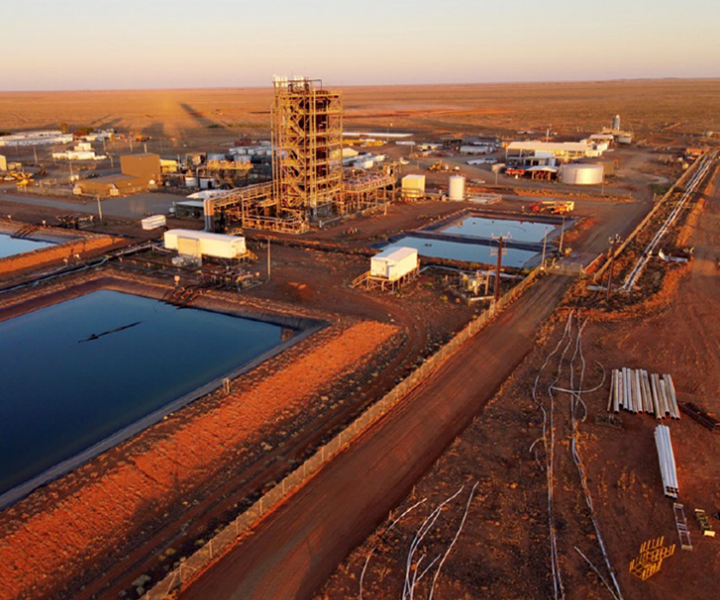
(Source: Boss Energy)
The situation
ISR amenability, being the viability of a uranium deposit to be mined using ISR, requires two critical parameters; a permeable host formation and favourable hydro and geo-chemistries.
Porosity, and particularly free fluid porosity coupled with mineral and groundwater chemistry, form the factors required to properly model the required fluid volumes, injection rates, and lixiviant chemistry for effective mining. In addition, formation permeability (hydraulic conductivity) is also a primary driver in assessing resource recovery rate.
Traditionally, formation porosity and permeability are measured on core samples in a lab. Core drilling and analysis can be expensive undertakings and slow to deliver final usable results. Alternatively, permeability and hydraulic conductivity can be determined via pump and slug tests. However, pump and slug tests require fully installed wells screened in the appropriate zone before testing can even take place, adding to the overall operation costs.
Wireline logging technologies are used extensively in uranium ISR because they offer faster data acquisition. Additionally, wireline technology is more cost-effective compared to alternative methods and provides a continuous dataset, making it a preferred choice for uranium exploration, delineation, and mining.
Technical solutions
WIREBmr™ is a downhole geophysics tool that measures water contained in subsurface environments safely and accurately. WIREBmr™ is specifically tuned to sense fluids within the pore network, enabling precise determination of the formation’s total porosity, mobile fluid content and bound fluid content. Formation permeability is also calculated without requiring additional wireline data. WIREBmr™ eliminates the need for other wireline methods that may not function well in PVC wells or heavily rely on local calibration, providing a reliable and safer alternative.
In situations where the overall water/brine content remains consistent throughout the borehole but the ratio of free to bound fluids varies, it's crucial to classify intervals as either an aquifer (containing abundant free fluids) or an aquitard (containing mostly bound or no fluids). With WIREBmr™, it becomes possible to break down the total porosity into different mobility categories, enabling accurate estimation of the effective porosity and the identification of fluids trapped in clay and shales, which will not flow under an injection/extraction regime.
The result
Using WIREBmr™ the mine geology team at Boss Energy now have increased confidence in the reliability of their geological interpretation, which was previously based on a combined gamma-gamma density/neutron and resistivity regime. In addition, the team has been able to generate area specific models for porosity and permeability where previously a reliance on sparsely sampled core and pump tests were the only option.
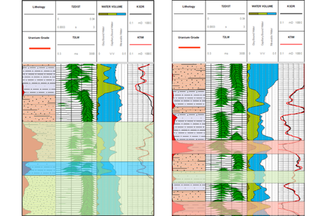
Figure 3 (right): highlights uranium accumulation in low permeability clays indicating poor ISR amenability. Minor grade accumulation in sand dominated interval indicates higher ISR amenability in this intersection.
Orica wishes to thank Honeymoon Mine and Boss Energy for their support and permission to publish this case study.
Author: Nick Jervis-Bardy
"WIREBmr has provided us with greater confidence in our lithological interpretation and the planning of our wellfields."
— Ryan Gore, Senior Mine Geologist, Boss Energy
Increased confidence
WIREBmr™ increased Boss Energy's confidence in reliability of geological information, and can now generate specific models for porosity and permeability.
WIREBmr™
Learn more about how WIREBmr™ can support your operations.