Climate

Our climate strategy

Our climate change strategy focuses on building long-term economic resilience, accelerating decarbonisation across our operations, embedding climate considerations into decision-making and catalysing climate action across our value chain.

Watch our interview with Meredith Read - Head of Sustainability.

Sustainability Report

About Orica's climate targets

Our targets are informed by the Science Based Targets initiative (SBTi) and aligned with the goals of the Paris Agreement, using the Absolute Contraction Approach. In 2024, Orica provided feedback on the SBTi’s draft Chemicals Sector Guidance. Given the complexity of the chemicals sector and the hard to abate nature of our operations and value chain, we do not intend to seek SBTi validation for the full suite of Orica's commitments in the near term. Our re baselining approach is guided by The Global GHG Accounting and Reporting Standard for the Financial Industry.
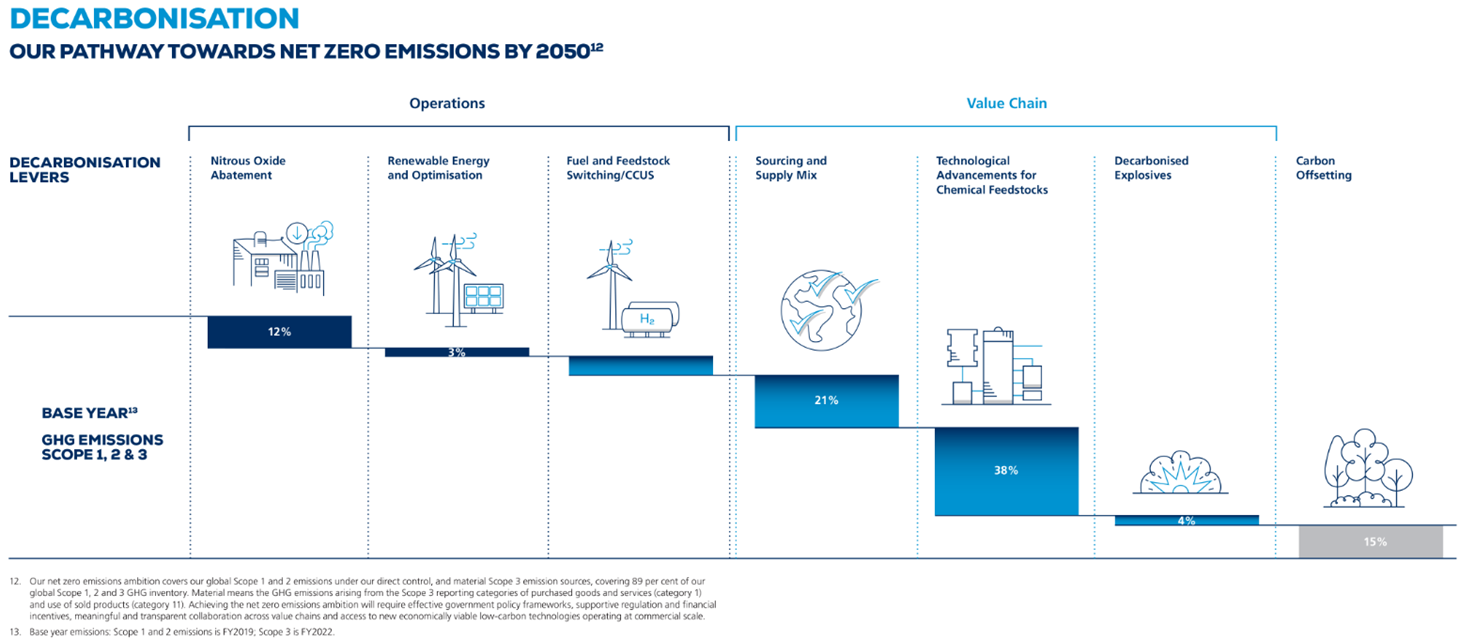
Decarbonisation-2050-pathway-2025

Delivering on our climate pathway

One of the most significant levers in our decarbonisation pathway has been the implementation of tertiary catalytic abatement across our nitric acid manufacturing assets. This technology has delivered substantial emissions reductions and continues to play a central role in achieving our near‑term climate targets.

Operational net Scope 1 and 2 emissions targets

  • 30% reduction by 2026 from 2019 levels1
  • At least 45% reduction by 2030 from 2019 levels1

Renewable electricity targets

  • 60% renewable electricity by 20302
  • 100% renewable electricity by 20402

Scope 3 emissions ambition

  • 25% reduction by 2035 from 2022 levels3,4

Net zero emissions ambition

  • To achieve net zero emissions4,5 by 2050

Progress to date

  • 41% reduction in operational net scope 1 and 2 emissions in 2025 from 2019 levels.

  • 22% per cent renewable electricity in 2025.

1. Applies to existing operations and covers more than 95 per cent of Scope 1 and Scope 2 GHG emissions. Base year emissions will be recalculated consistent with GHG Protocol emissions accounting standards if structural changes occur such as acquisitions or divestments.

2. Target boundary excludes small sites (e.g., single remote offices, depots), markets where total consumption is less than 100 MWh pa, or countries where credible sourcing options do not exist.

3. Coverage includes all reported Scope 3 emissions across the 12 of the 15 Scope 3 reporting categories deemed relevant to Orica. Base year emissions will be recalculated consistent with GHG Protocol emissions accounting standards if methodology or structural changes occur such as acquisitions or divestments.

4. Achieving the net zero emissions and Scope 3 ambition will require effective government policy frameworks, supportive regulation and financial incentives, meaningful and transparent collaboration across value chains and access to new economically viable low‑carbon technologies operating at commercial scale.

5. Our net zero emissions ambition covers our global Scope 1 and 2 emissions under our direct control, and material Scope 3 emission sources, covering 89% of our global Scope 1, 2 and 3 GHG inventory. Material means the GHG emissions arising from the Scope 3 reporting categories of purchased goods and services (category 1) and use of sold products (category 11).

Accelerating climate action

Our climate change strategy, underpinned by our Climate Change Policy, focuses on strengthening Orica’s long‑term resilience, accelerating decarbonisation across our operations, embedding climate considerations into decision‑making, and catalysing emissions reduction across our value chain in line with the goals of the Paris Agreement.
Latest reports

Our sustainability reports and supplementary materials provide further details about our performance.