Case Study
Reducing packer testing cost and time with WIREBmr™
25 Sept 2024
Project Profile
A new nuclear power plant was proposed to be built off the northwest coast of Wales, with a cable tunnel route under the Menai Strait connecting to the National Electricity Grid. The site investigation for the tunnel route was developed by design consultant Mott MacDonald in consultation with site investigation contractor Fugro, and the client, National Grid.
In tunnel excavation applications, accurately characterising the geo-mechanical and hydrogeological properties of the formations along the route are critical for not only the drilling and construction planning of the tunnel, but also for mitigating the risk and cost associated with potential equipment or tunnel failures. When a proposed tunnel route is located undersea, additional considerations related to connectivity of the waterbody above the tunnel need to be well understood.
The situation
Typically, a highly detailed geotechnical site investigation program is required for tunnelling projects. The subject work program includes coring, advanced geophysical wireline logging, ground water sampling and packer testing. Analysed core drill cuttings and water samples obtain rock and formation water properties, and geophysical wireline logging and packer testing measures in-situ water and rock properties.
To conduct the undersea portion of the site investigation, Fugro’s specifically developed nearshore jack-up barge (Aran120) was selected for drilling and coring, and also for providing the platform and support for the measurement program. Overwater work adds significant time and cost for logistics compared to land-based ground investigation. Weather conditions can also adversely impact project time scale as both rig moves between borehole locations and high wind conditions can cause unsafe working conditions on the vessel platform.
As a result program efficiency and reliability is a high priority, second to securing the requisite data. With drilling and coring penetration rates mainly a product of the formation types being drilled, cost reduction opportunities mainly exist in reducing and refining the measurement program time to reduce associated rig time costs.
Technical solutions
Orica Digital Solutions collaborated with Fugro and Mott MacDonald, identifying an opportunity to use WIREBmr™ to reduce the overall project time by refining the packer testing program.
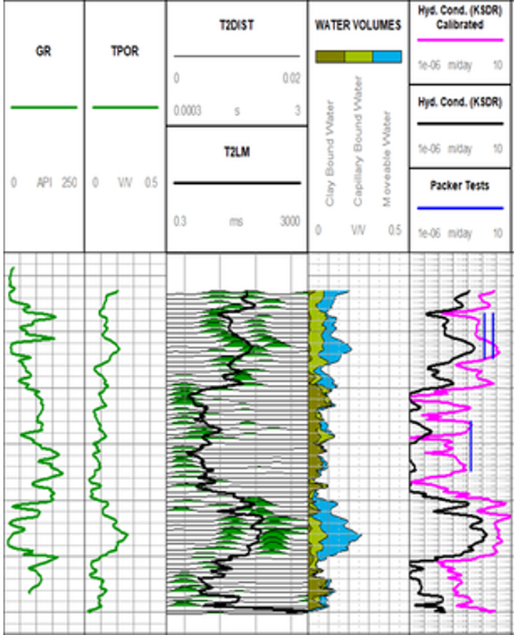
WIREBmr™ directly measures lithology independent total porosity and pore size distribution, using magnets and an antenna to interact with the water in a pore space. When lithological information is available, total porosity can be divided into components such as bound and movable water, as well as calculate estimates for hydraulic conductivity and transmissivity using equations with standard global coefficients.
WIREBmr™ logging, combined with real-time processing turnaround, was added to the geophysical wireline logging program. WIREBmr™ was typically conducted on the second or third run, allowing processing of the data to provide a continuous vertical profile of hydraulic conductivity from bottom to top of the open hole section prior to completing the remaining log runs. This allows for selecting packer test zones of interest based on measured in-situ data without any time delay to the packer test program. The same log is utilised to select appropriate interval lengths as well as suitable packer set depth locations in order to isolate and successfully test the zones of interest.
Results from the packer tests that investigate further into formation and fractures can then be compared to the near borehole hydraulic conductivity results from WIREBmr™. Region specific co-efficients can also be determined with calibration of the WIREBmr™ data to the results from packer testing.
The result
WIREBmr™ saved cost and time from the ground investigation program for the proposed Menai Strait cable tunnel, reducing packer testing on average from 8 to 3 tests per hole, resulting in a minimum rig time decrease of 15hrs per borehole.
The continuous hydraulic conductivity log acquired allowed accurate targeting of conductive zones for the remaining packer tests improving the quality of data acquired and site understanding.
In addition, avoiding borehole instability by limiting the damage from packer testing reduces the complexity of borehole grouting and sealing operations required prior to moving to the next location.
WIREBmr™ was successfully utilised to refine the packer testing program in the initial boreholes. A calibration was then performed, with subsequent logging and packer testing validating the correlation and resulting in a significant reduction in the packer testing program moving forward.
Orica Digital Solutions wishes to thank Mott MacDonald their support and permission to publish this case study.
Author: Ryan Gee
"The use of WIREBmr enabled us to collect continuous hydraulic conductivity data for the full depth of the boreholes, allowing us to optimise the number of packer tests and to target specific areas for further tests.
This technique provided further detail and confidence in the packer test results, and allowed us to reduce the duration of the overwater investigation works."
— Gareth Mason, Principal Engineering Geologist
15 hour reduction in rig time
WIREBmr™ saved cost and time from the ground investigation program, reducing packer testing on average from 8 to 3 tests per hole, resulting in a minimum rig time decrease of 15 hours per borehole.
WIREBmr™
Learn more about how WIREBmr™ can support your operations.